swap to chronological order of most recently posted
-
just the photos! all the photos! nothing but the photos!
-
I now have a beautiful new digital mirrorless camera + gorgeous telephoto lens to take on adventures! But I cannot willingly do so without a protective case.
What I’d like is a very lightweight sling or messenger style bag that lets me keep my camera assembled, so I can easily pull it out and then pop it back in depending on terrain, transit, weather, etc. Something that doesn’t look too high tech would be nice, but I definitely am more worried about padding, weatherproofing, etc. than looks. If it’s big enough to also carry some sketching supplies, that’s a win, but not my first concern.
I’m gonna try and hit up some camera shops downtown in a week or two to fulfill this quest.
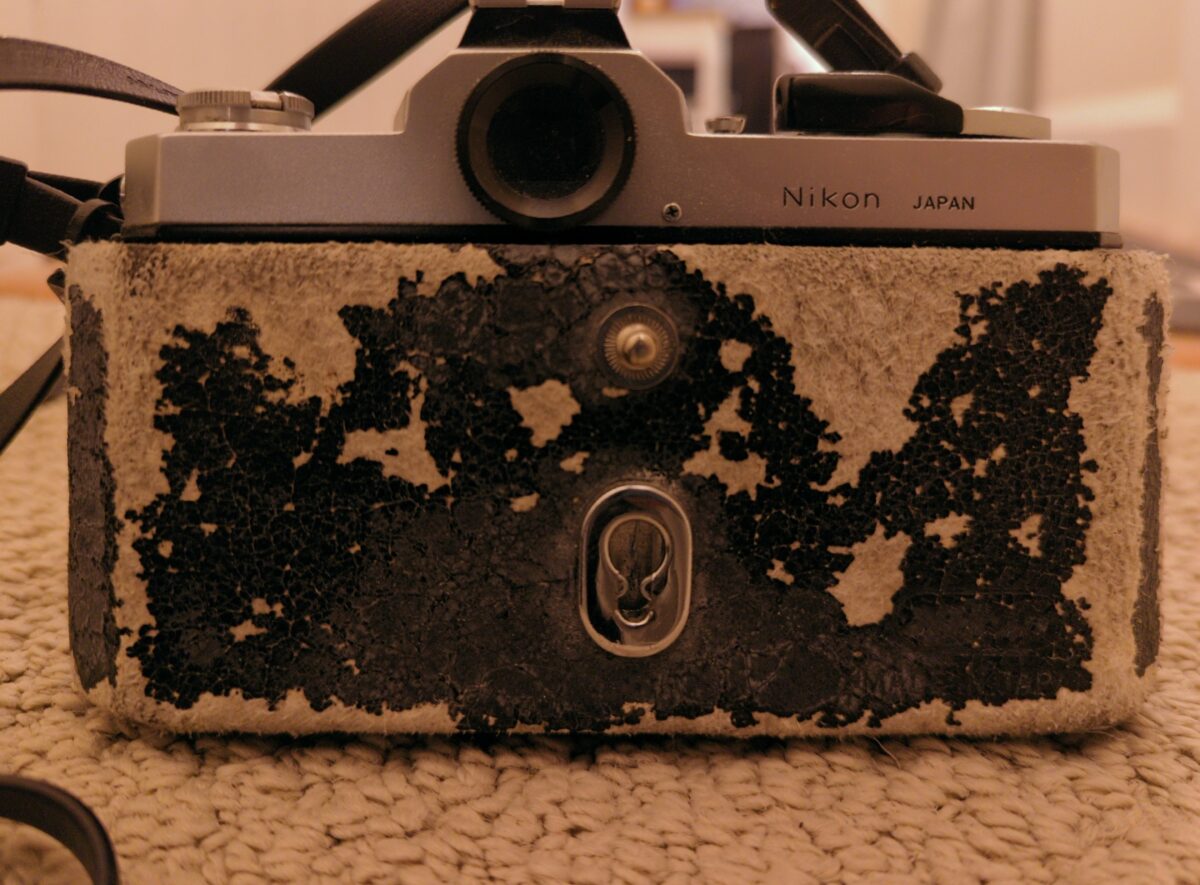
Pictured: the leather case I somehow still have for my dad’s 1970s nikkormat 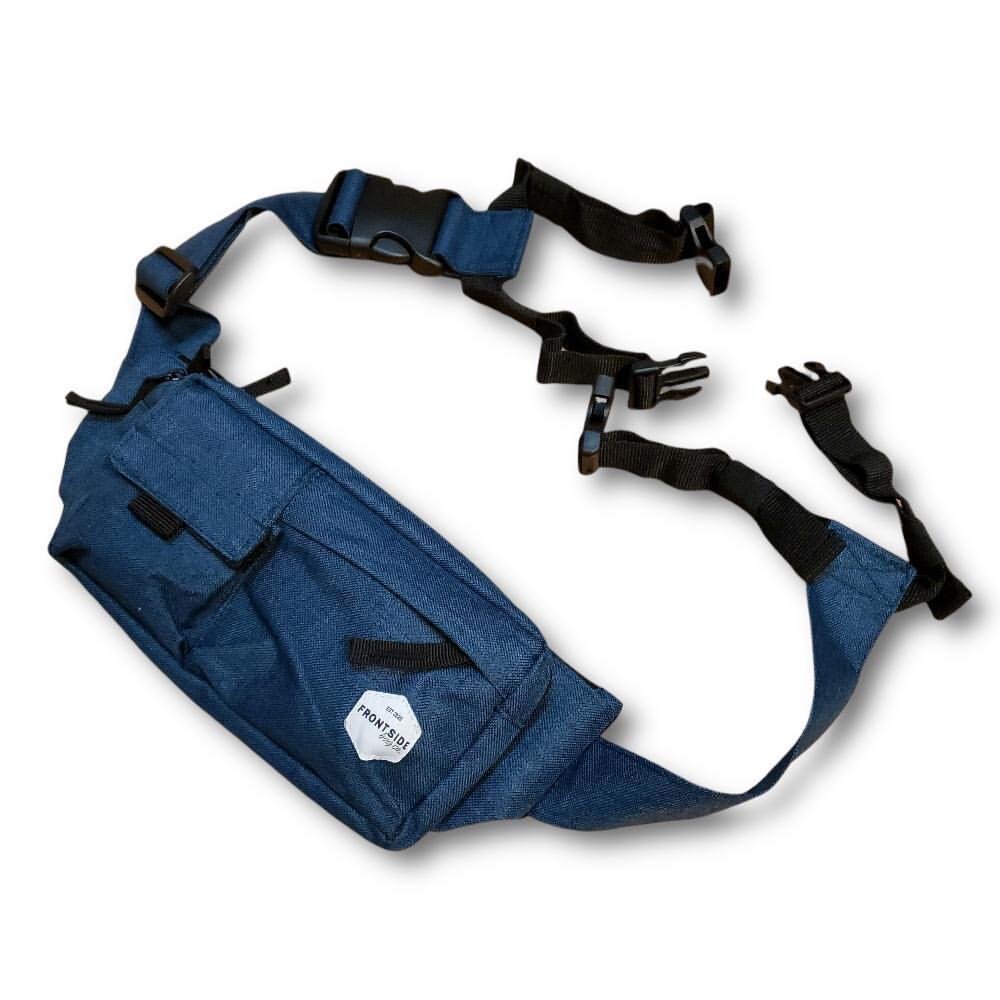
My partner has a weatherproof sling/crossbody bag that also carries his skateboard, very similar to this newer model I found, which is an amazingly targeted piece of equipment that also fits his camera! I’m pretty sure he could use the skateboard bits to carry a tripod instead, which is just old fashioned good design in my books. Anyways, what have you found, what do you love, what do you recommend keeping an eye out for?
thanks!
-
Recently having read that The Death of the Artist book, wherein a subchapter detailed at length not just the brutal gentrification process that artist presence in a neighbourhood is part of/causes/is a result of, but lays out how, in intentional urban neighbourhood design, the visible presence of artists is considered an amenity for middle class residents and sought as such (though apparently we are replaceable by small fun restaurants? feels great.)
It’s bleak, but it got me thinking again about ecosystem metaphors and how artists (and in the book it tries to use artists to mean an umbrella term that includes writing, film, music, etc., but I would argue that in the visible-as-neighbourhood-amenity sense, artists means visual artists, musicians and maybe sometimes filmmakers, depending on their visibility/indie-ness) are this sort of decorative scavenger presence that dramatically change an ecosystem, even so much as to make it uninhabitable for themselves.
And that got me thinking about whale falls, and how for very new, utterly unsuccessful artists, an urban presence in terms of occupied space is often only really possible in the liminal moments of transformation of the space – when one round of neighbourhood occupants has left and the other not yet moved in, as it were.
Pop-ups.
I got to be in a gallery pop-up for the third ever Nuit Blanche in Toronto. It was very new and very respectable at the time as an event and it also happened only in particularly artsy neighbourhoods still. I had graduated that May and so by September, myself and my fellow fine art grads had come to the realization that we were going to have to haul ourselves up into the fine art world by our bootstraps apparently, and we quickly formed a slightly incoherent collective, pooled our funds, and booked a small manufacturing warehouse in the Right Neighbourhood and pulled together a group show for Nuit Blanche.
This was not my first nor my last artist collective, but it met a similarly dispersed end. As far as I know, only one of the … eleven or twelve? of us? went on to become a gallery artist, and unfortunately I’m out of touch with everyone from that point in my life. You may have noticed I am a commercial artist now.
Anyways! A pop-up gallery by a bunch of 21-year-olds four months out of art school, smack dab in the middle of the biggest art walk event in our large and culturally illustrious city.
This was only even possible because the warehouse was empty at the time; and it was empty because it had been sold to a developer who would shortly gut it and build something much more expensive in its place. For Toronto locals, this was at Queen and Ossington, a neighbourhood I can’t afford to eat in regularly anymore, even with my commercial art career income, moretheless rent retail-adjacent commercial space for a full month.
These sorts of nearly-dead spaces in otherwise vibrant neighbourhoods undergoing the inevitable condoification are almost always filled by pop-ups – gallery pop-ups, small businesses, catering companies testing out restaurant life, tattoo studios designed to pack up quickly at the end of their temporary lease. These all still pay rent to the landlord, whether the original one or the future condo tower owner, I imagine it varies. They wring the last little bit of potential out of the space – they pick the bones, as it were.
All these lost art students and ambitious young chefs and body mod artists just spreading out over the urban abyssal plain, waiting for some decaying piece of property to become briefly accessible, and then lighting it up with culture and drama and foot traffic like a brief firework before it ultimately fully disappears into the grey sands of unaffordable rent.
Even the Starbucks that opened in that neighbourhood as a harbinger of the great Gentrification Construction Wave is gone now, by the way.
-
For six months I had no nerve connection whatsoever to my lower right radial nerve. This meant that all of the muscles it powered were completely switched off, paralyzed, leaving me unable to uncurl my fingers, lift my wrist, tilt my wrist, or open my thumb, and leaving me much weaker at gripping, rotating my lower arm at the elbow, and bending my elbow. This had a waterfall effect – with less function, the arm as a whole gets used less, and the whole arm weakens and loses muscle mass, even in muscles still fully powered by healthy nerve connections. This meant my right arm actually became less useful over the course of those six months after surgery, in a bad but somewhat inevitable feedback loop.
I knew this was coming, and i had started to prepare before surgery by training myself to do a few things left-handed – writing and drawing were the big ones, but not the only ones.
I also have some leftover left handed skills from having carpal tunnel back in 2007 – it was easy enough to switch over my mousing hand, for example, as I’d done it before several times, whenever my right wrist flared up. Easy, as mentioned in prior posts, as assessed on the new difficulty curve of my life.
Left-handed writing was a very strange thing to tackle – firstly, it is definitely different than right-handed writing. We’ve designed our letterforms to work with a very specific biomechanical setup, and the left hand flips it all completely.
There’s three distinct hand positions folks use to write left-handed – keeping your hand above the line, alongside the line, or below the line of text. Smearing your lines by rubbing your hand along them as you progress from left to right is a real frustration, and the above-the-line and below-the-line hand positions are both responses to that concern; but the internet was very certain that the above the line, curled-wrist hand position was a recipe for carpal tunnel, so given my experience with that I wanted to avoid it. This really only left me the below-the-line hand position for writing, and the problem with that was just how different it felt from writing right-handed.
Apparently the above-the-line hand position’s main advantage is how much it allows a left-handed writer to mimic the motions and shapes of right-handed writing. From my reading, it’s implied that this was mostly a benefit to teachers, who didn’t have time to teach two totally different systems of writing – but people who get into calligraphy left-handed tend to write from below the line, which gives them more natural wrist positions and still a whole suite of beautiful curves and swoops available to build the letters. In fact, the calligraphers I’ve found all universally turn the paper a full 90° and write from top to bottom instead of from left to right. Despite respecting their expertise, I really couldn’t get my brain around that fullly rotated page, and ended up writing from underneath with a maybe 20° tilt the other way, to help balance the natural backwards lean of my left handed letters.
As a geriatric millennial, I learned cursive writing in grade school, and I’m much more comfortable and fast with it than printing; I like taking handwritten notes in meetings, doing my brainstorming on paper, and I worked hard to be able to write as fast as I think. So my first and biggest writing concern was getting myself to learn left-handed cursive.
Well, folks, with cursive writing being forgotten at large and left handed writing of any kind being a specialized concern, there were not a lot of good resources on the internet. Many of them taught the curled-wrist above-the-line hand position and then reproduced the same letterforms and line directions as right-handed writing. But it’s patently obvious to me that left-handed cursive needs to respond to left-handed biomechanics, and folks, it’s been a real pain to track anything like that down online, except in the world of calligraphy.
Which is why I spent six months getting deeeeeeep into calligraphy.
Shoutout to left handed calligraphers through the ages for approaching their craft so seriously and for sharing their methods so generously! From out of print books on the internet archive to real time demonstrations from Instagram calligraphy artists, the world of left-handed calligraphy was an extremely inspiring and amazingly professional scene to drop into for a while.
After relearning my usual cursive with my left hand, to keep things interesting I decided to learn a few other scripts as well. Once you’ve overthought the shape of the letter A for a day or two just to get to one comfortable iteration of it, it’s not a big leap to then start exploring other variations of it just for fun.
I hesitate to assign silver linings to this whole experience at this stage still, but I will admit that having to relearn how to write with my opposite hand has made me really relearn what writing is – what letters are, how they work, how we draw them, how we read them, what different scripts etc actually mean. I care more about letterforms and fonts and such than I ever did before, and it’s made writing a lot more interesting!
But don’t assume that meant any of this was easy, or particularly intuitive, or at all relaxing.
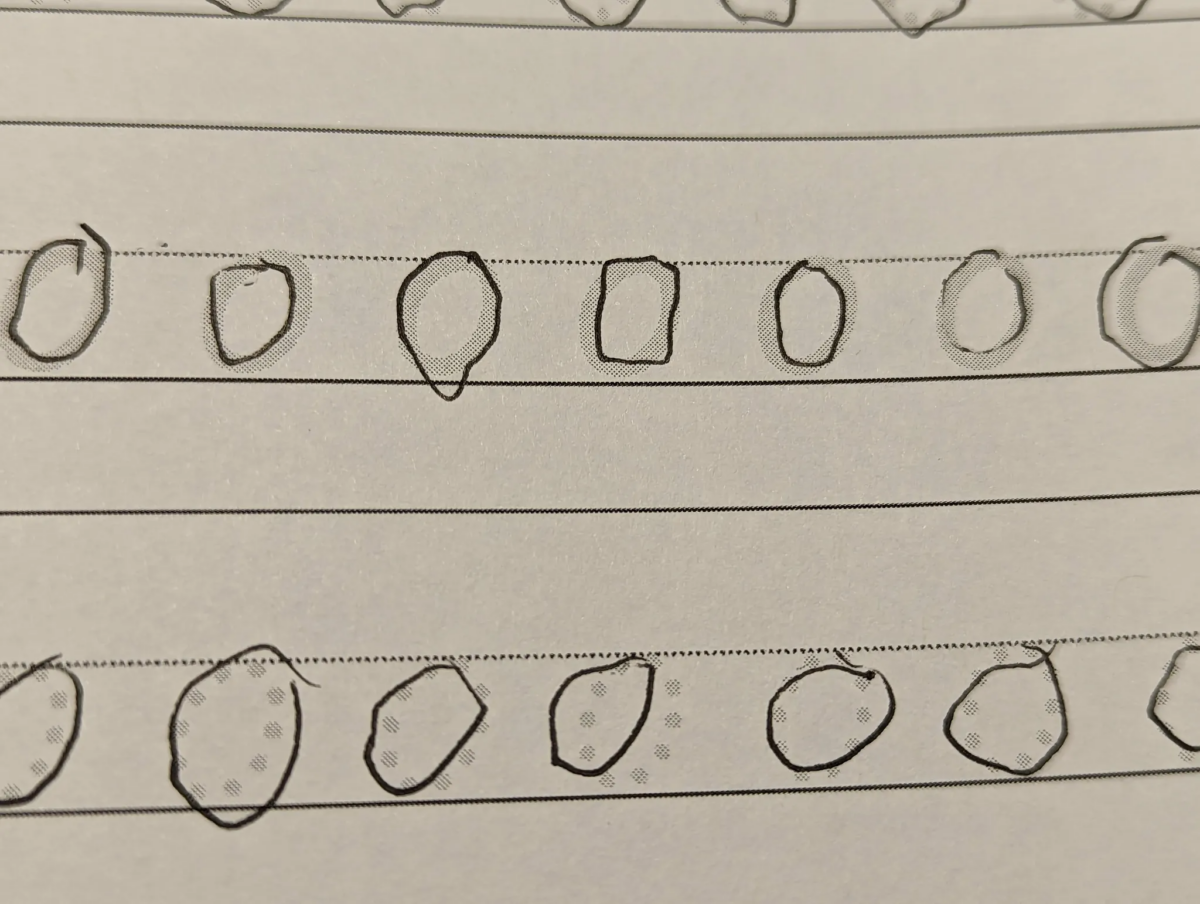
I did purchase some learn-to-write workbooks and tried just filling them out to measure my practice, but as you can see, it was both rough going and mind-numbingly boring. Initially my left hand couldn’t reliably make any particular marks whatsoever, whether straight, angled, round, etc. It never stopped requiring intense focus to write, and I usually have to sit and think about each individual letter I am recording to the page. This is not at all a replacement for how I used to write with my right hand – I really could move thoughts through my arm to the page without having to consciously translate them into letters at all, and my left hand, despite six months of complete immersion, never got anywhere close to that level of comfort.
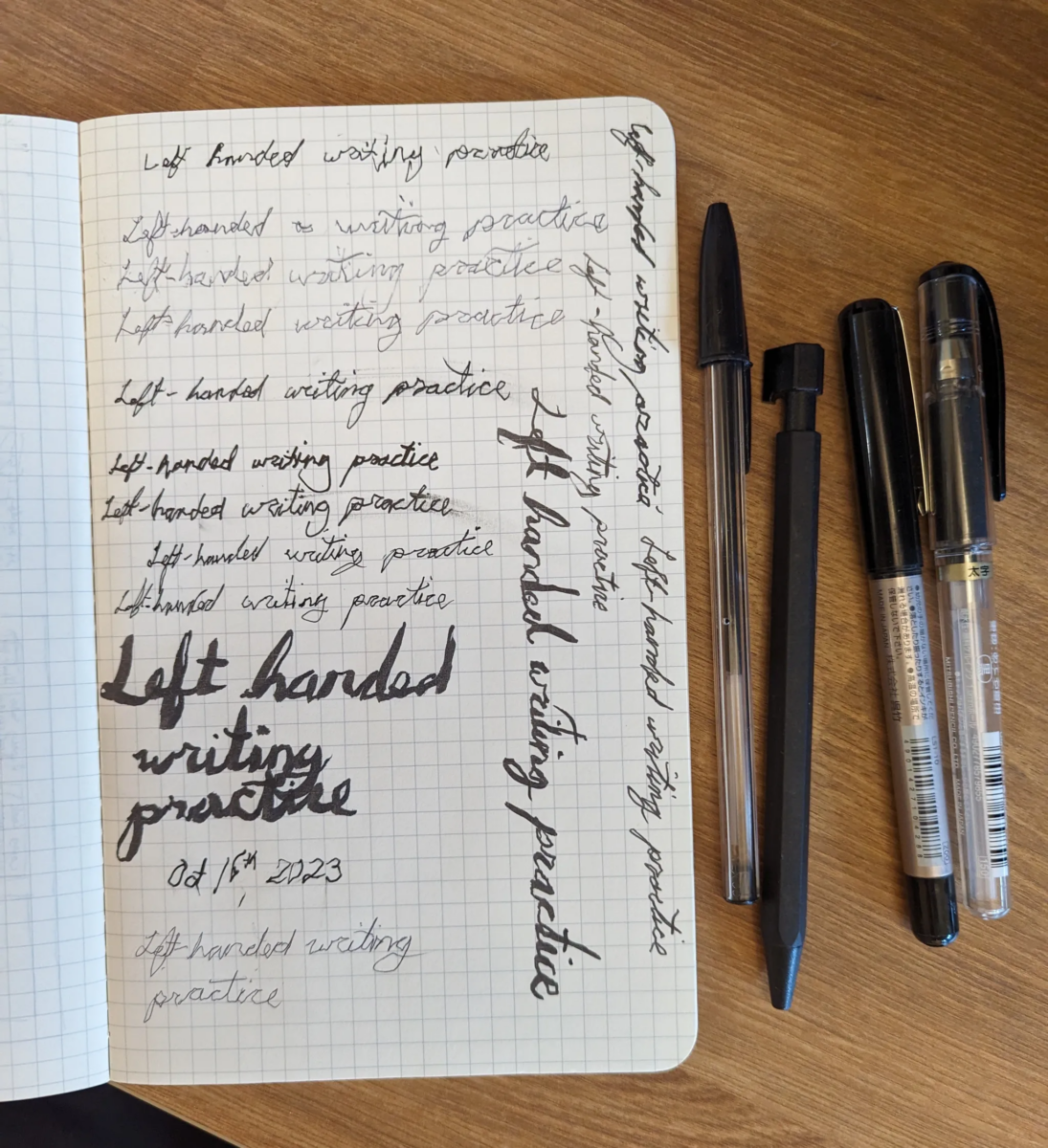
By February I was starting to hold the pen in my braced right hand again, which was exciting, but not at all a return to easy comfort. Additionally, it was legit confusing! but more on that in a later post.

-
After surgery, I had planned to take two weeks off of work. The actual surgery itself didn’t sound as intense as some prior ones I’ve had, but I had at least some sense that it would take some time to readjust.
In the end I took four weeks off, and I’m hugely grateful to my job and the team I work with for accomodating that so kindly. For those four weeks, I slept, recovered, panicked, vibed, walked in the park, researched accessibility aids, and screamed into pillows with the rage of a thousand suns.
I have never, in my adult life at least, felt so unrelentingly enragingly constantly frustrated as I did in those first four weeks. I fucked up everything I tried doing, and since almost all of the things I tried to do in that time were self care activities like drying my hair or texting with friends, that took a huge emotional toll.
Have you ever had a moment where clumsy mistakes chain together, and you drop something, stub your toe, bump your head, spill your drink, and fill a text window with typos when you try to tell someone about what just happened?
Some days it feels like I’ve been in that mode steadily since Oct 2023.
I spill food on myself. I miss my mouth when I drink from my water bottle. I drop things I’m holding; I click the wrong link while browsing; I whack everyone and everything with the padding on my arm brace.
It’s certainly at least a little better now, a year + later, partially because I’m getting less clumsy (less, not none), but definitely also because my frustration threshold has been forcably moved, a thing past me wouldn’t have believed could happen.
That first month was utterly enraging. Everything I tried to do the old way failed to work because I was doing it one-handed with the wrong hand; every new tool I tried that supposedly would improve my life turned out to have at minimum a big learning curve, and more often than not a whole range of capitalist cruft woven into it; and the whole time I was locked in a vicious internal battle against all the toxic independance and deepseated ableist shame that had been waiting for me in my head.
I’m maybe making light here, but the rage was exhausting. I took four full weeks off of work, and I am glad I did, because I was not in a state where I would have been a positive presence on my team.
The frustration is still there; the shame and toxic independance are still there.
I misclick with my left handed mouse and close the screen I was on without saving, and the red fog threatens to roll back in.
A friend lovingly jokes about the nonsense that a dictation tool made out of my attempt to text them, and the mental tornado siren starts to spin up.
I burn myself mildly on the airfryer trying to cook dinner solo, and every curseword I know lines up behind my tongue, promising catharsis.
I am, however, less overwhelmed by it, than I was that first month. That’s largely thanks to arsenal of management techniques I have built up: I step away, I take breaks, I made a catharsis playlist for when a big feeling starts camping out in me and I can’t dislodge it. I know that having eaten is the first key to patience. And I know that some days I am just going to have to label as “FUBAR” on the calendar and treat as throwaways. But yes. Recovery has been frustrating.
-
When all this was ramping up, I tried to do a lot of research into what tools I would need to navigate the world with my left hand, and there were two things flooding my search results: things for parents to buy for their left-handed kindergarteners, and mensa nerds looking to minmax their IQ by becoming ambidextrous.
So, life seems, at least from dipping my toe in it, to be a liiitttle bit condescending to left-handed people still.
My parents’ generation were kids back when teachers would smack you if you tried to write with your left hand, and it does seem significantly good that we don’t do THAT anymore, but, goddamn. There are a LOT of apparently right-hand-specialized tools that don’t SEEM specialized at first glance.
Left-handed scissors were by FAR the best thing I purchased: without relearning how to use scissors, using right-handed scissors in my left hand is deeply annoying. Left handed scissors work instantly with no learning curve. They contain no software, they are available most places I see any scissors (tho, def not all), and they weren’t marked up hugely over the right-handed scissors I saw in the same stores.
Left-hand dominant folks I know can all use left or right-handed scissors; left-handed ones just change how they see what they’re cutting, and how ergonomic the pressure required to cut is. They make my day to day slightly easier and I appreciate them immensely.
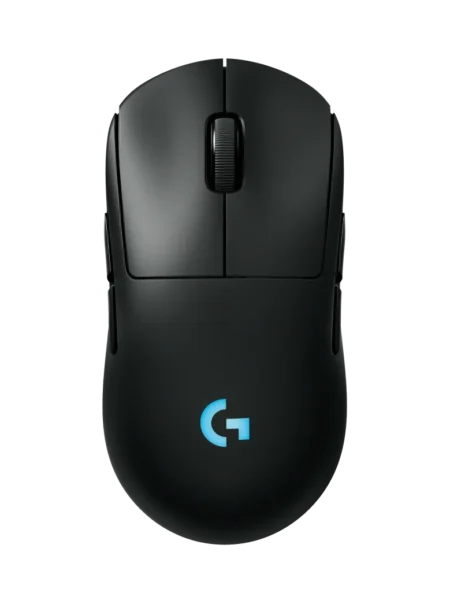
Left-handed mice are a lot harder to find; while I don’t think hand dominance and mouse hand choice is usually connected for most folks, having no ability to extend (lift) my fingers on my right hand meant mousing with it was out of the question. Being able to mouse with both hands really helped me back in my carpal tunnel days and I was determined to find a gaming mouse for my left hand for this recovery period. In the end I found an ambidextrous Logitech – the Pro 2 Lightspeed: you can change which side has the extra buttons, which is a really great feature, and when I am mousing more with both hands I might enable the buttons on both sides and duplicate their function.
In the specialized realm of music and sports there are left-handed alternatives for string instruments, for golf clubs, baseball gloves, etc. That was no surprise.
As I dug into it, though, it seemed to spiral. Did you know kitchen knives are sharpened with right-handed use in mind? Can openers absolutely are designed for right-hand dominance. Corkscrews and screwdrivers and so forth are designed expecting the strongest force on them to be compatible with the strongest force capable in a right hand. None of this PREVENTS left-handed use! It just means that left-handed use is slightly (or significantly sometimes) less ergonomic.
Slightly less ergonomic might not be a big deal when you’re able bodied, and when you’ve spent your life learning to accomodate that slight hurdle. And, as my uncles tell me, it’s a lot better nowadays than when they’d come home with welts on the back of their left hands for writing with the wrong one in class. (They rarely use left-hand specific tools as there was no chance of those being available when they were learning things as kids.) But it DOES add a layer when you’re NOT ablebodied, or have anything else adding exhaustion to your day.
Anyways, left-handed-ness. The world seems more annoying for left-hand dominance than I had realized. Sorry for my prior ignorance!
-
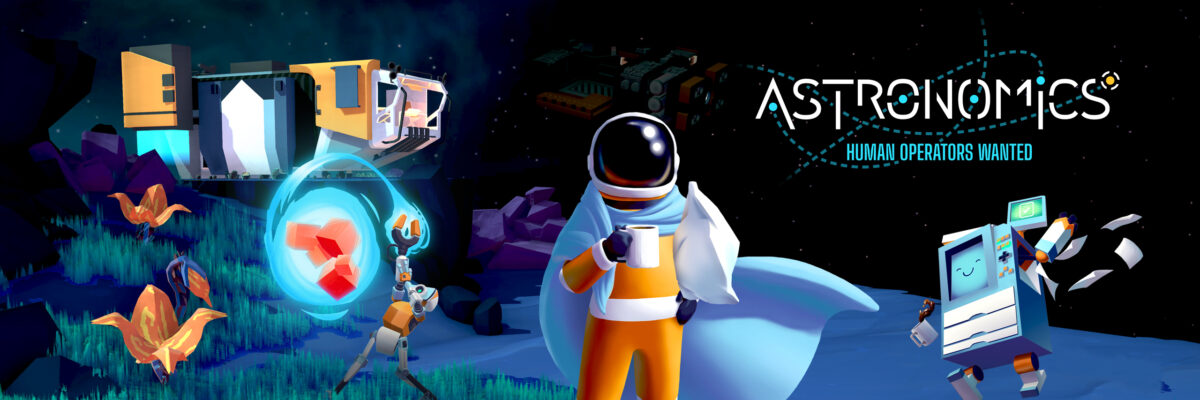
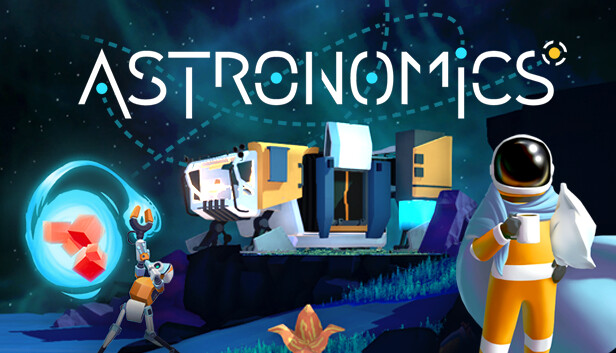
Astronomics! It’s out! You can play it! I’ve spoken a bit about this previously but this is my first published Art Direction credit and you can bet it means a lot to me! You should go look at the steam page and see how hecking charming this game turned out:
Also, you can take a look at the slick announcement trailer they made:
Important note: Hube & the team at Numizmatic have released the game as an early access game on steam, but don’t let that fool you – this is already a big game, with gameplay from start to finish available and an incredible number of possible asteroids to encounter, thanks to the wonderful procedural asteroid design! They’ve published a roadmap for the next updates and more info on how they’re approaching early access on the game’s website.
And in wonderful news, people are really enjoying it! There are MULTIPLE enthusiastic review videos, and folks on steam are really singing its praises!
I definitely want to talk more about the experience of designing this game right at the start of its life, but I’ll save that for a later blog post. Meanwhile, let me leave you with the three main characters, to whom I am disproportionately attached:


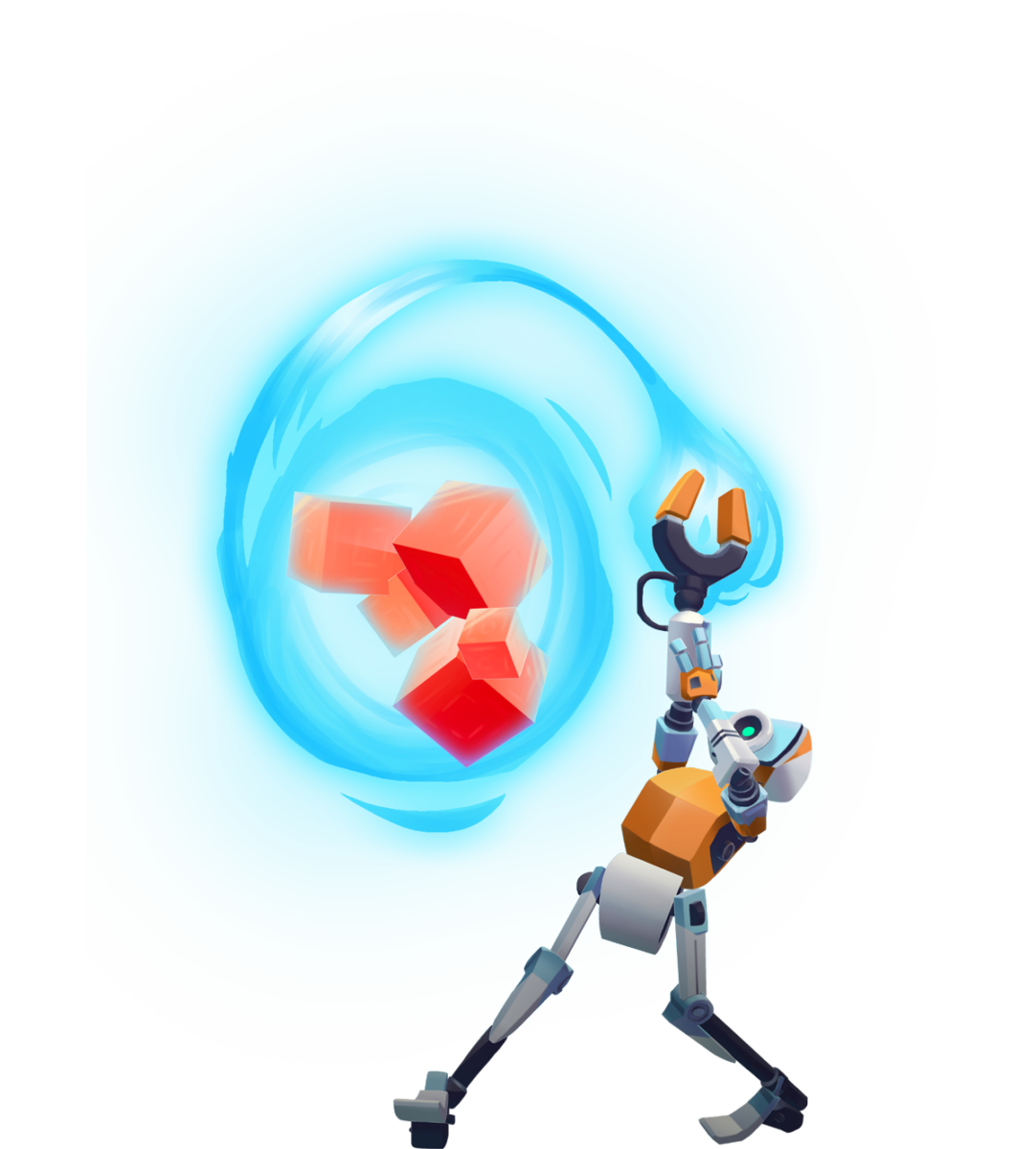
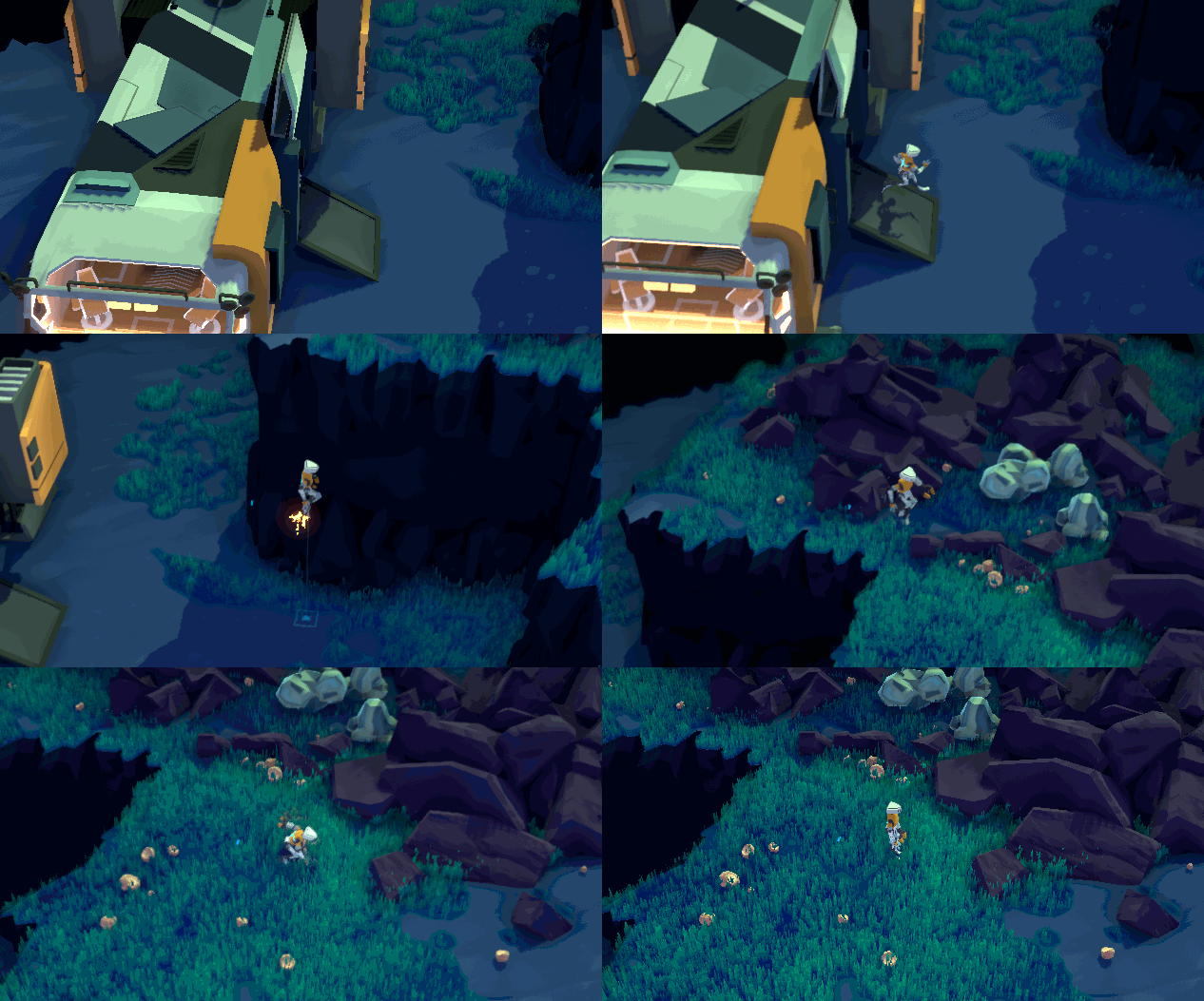
look at him! look at this little guy!
-
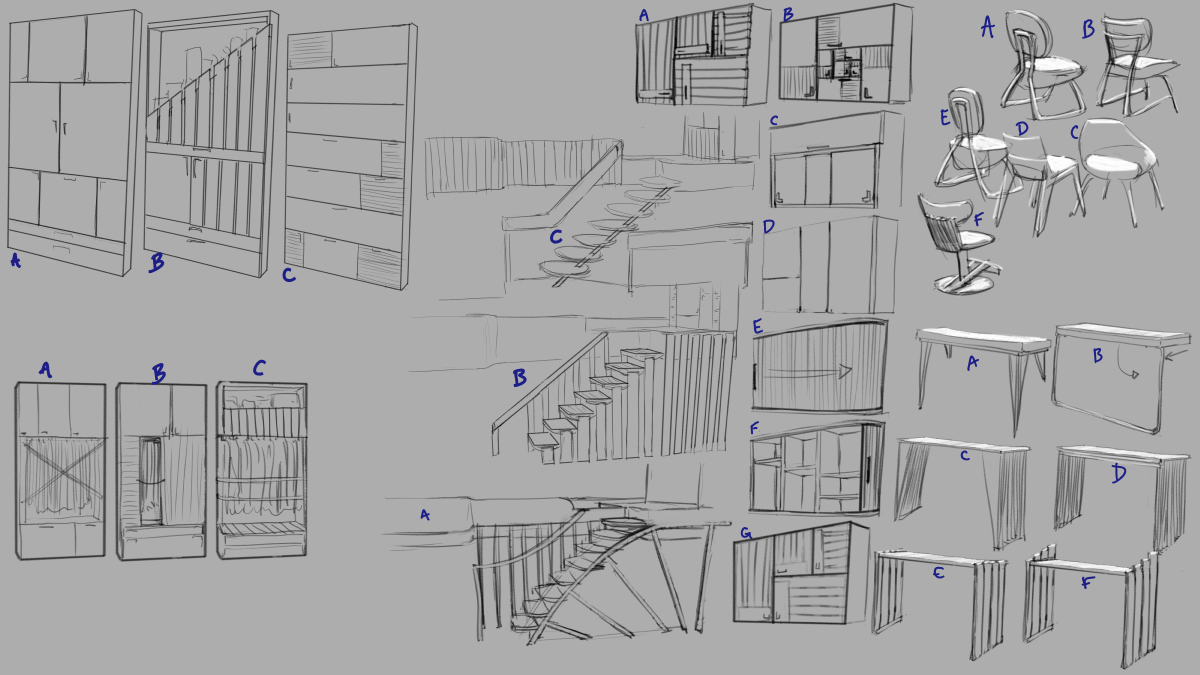
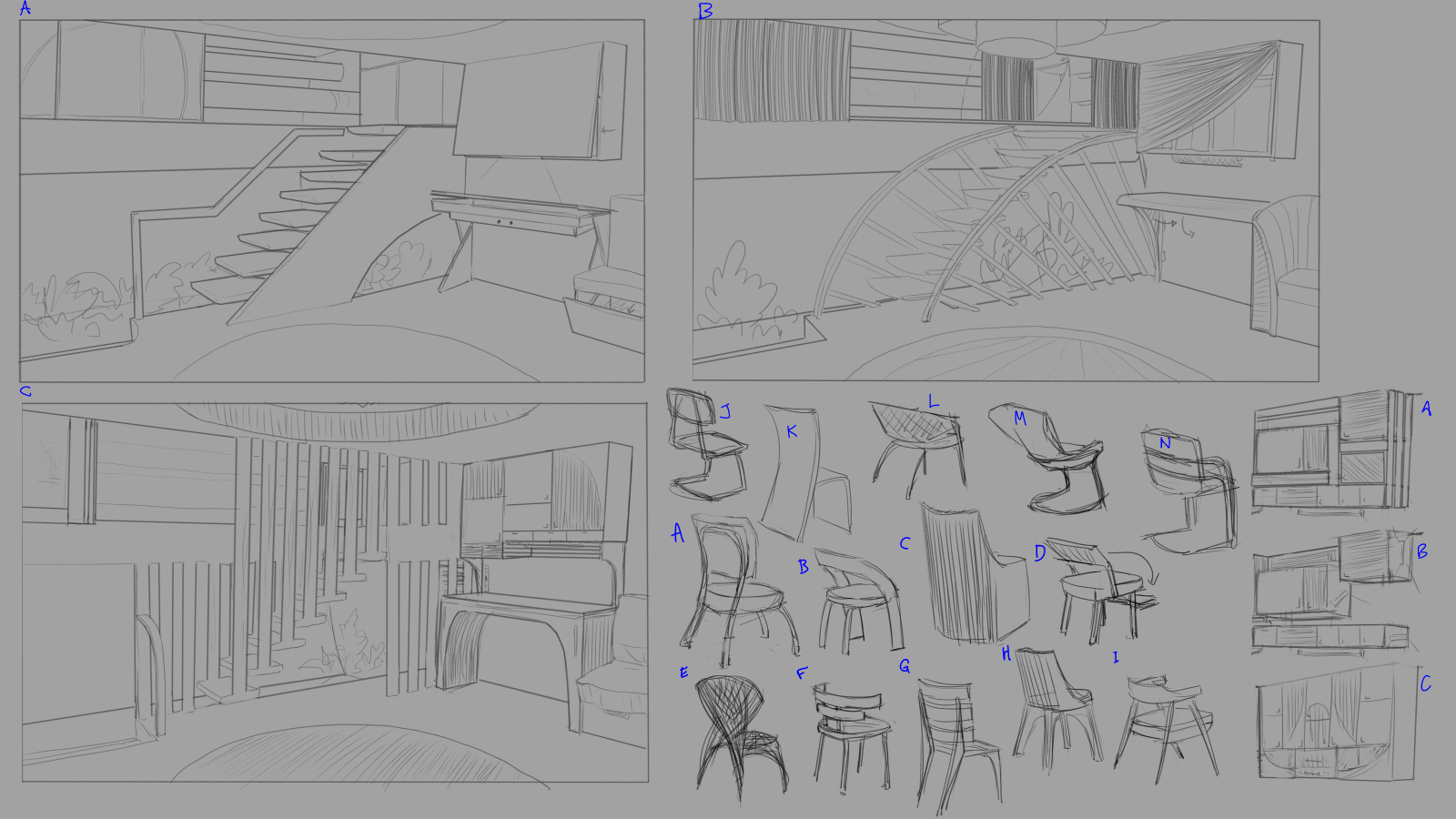
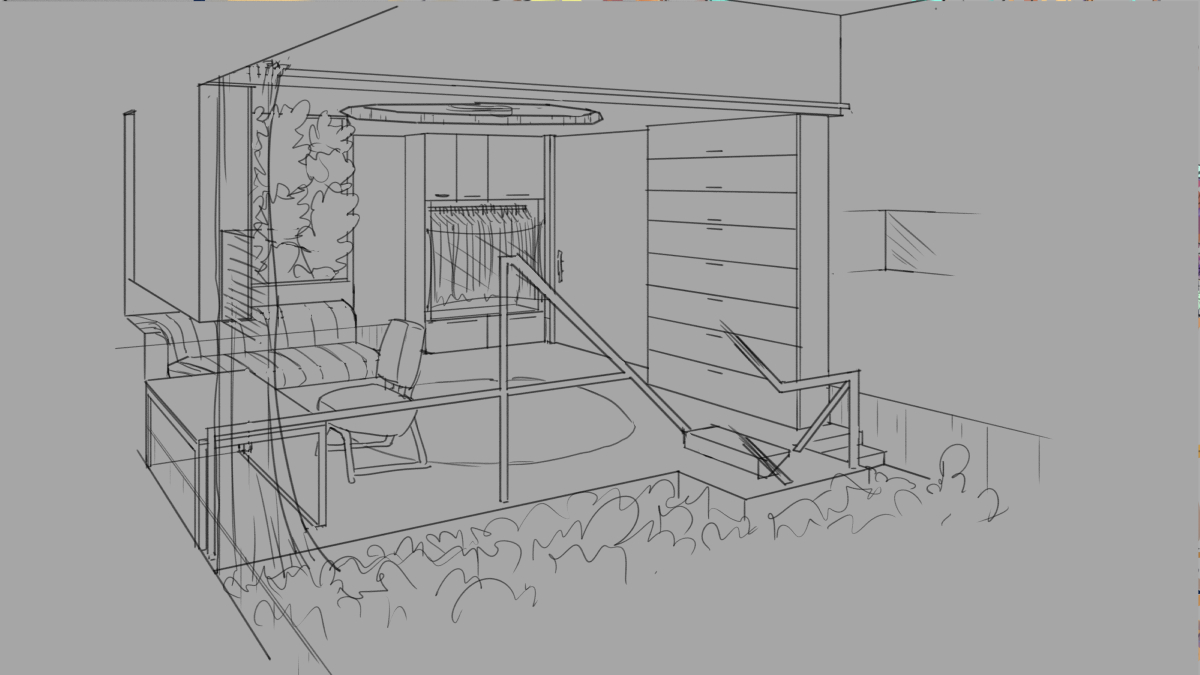
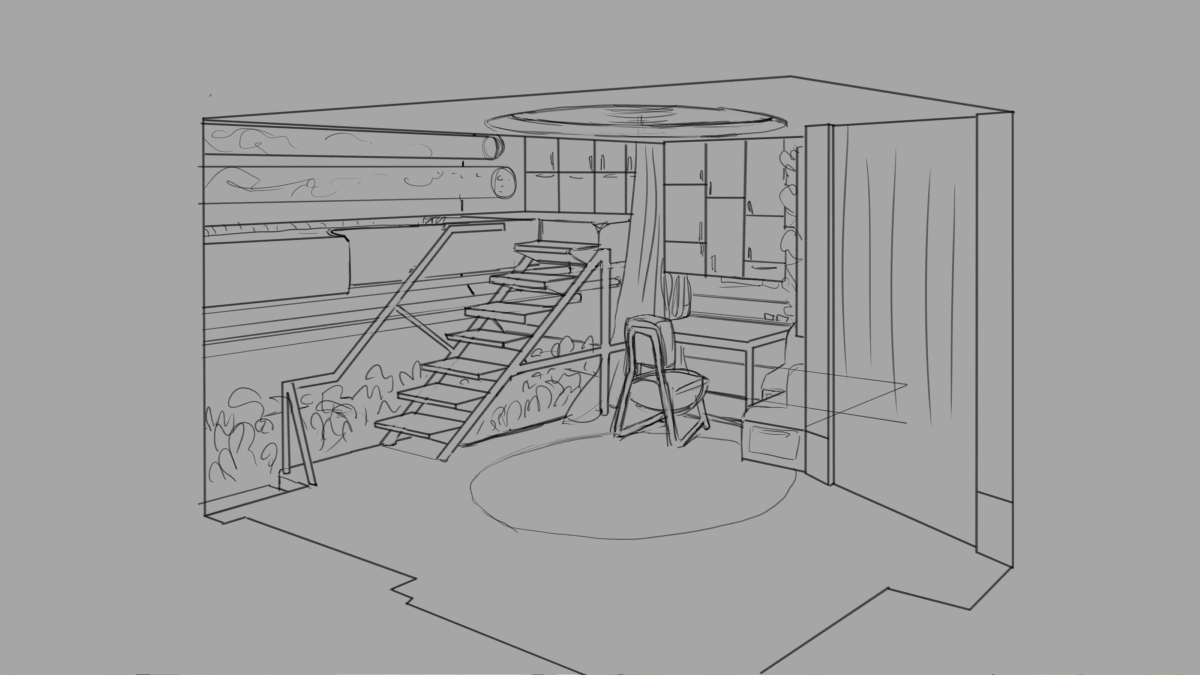
We did a pass exploring a more contemporary/futuristic aesthetic for the setting, focusing again on a cabin as a proof of concept, integrating elements from cutting edge material work in architecture and design.
The client provided a 3D blockout and some basic lights, built off of the floor plan and elevations, that I used as greyboxes to iterate the design. Here are the four directions we highlighted as possible approaches.
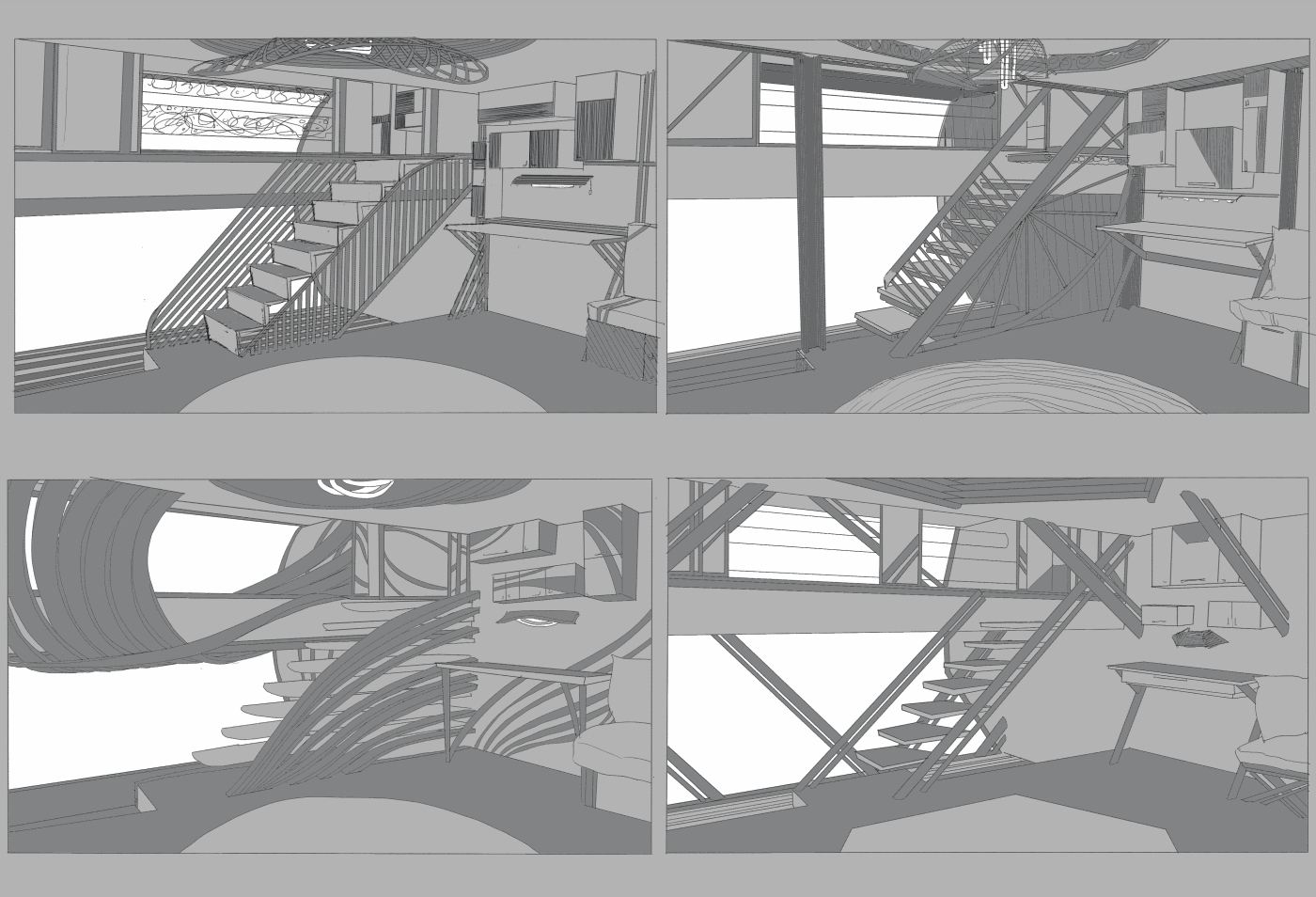
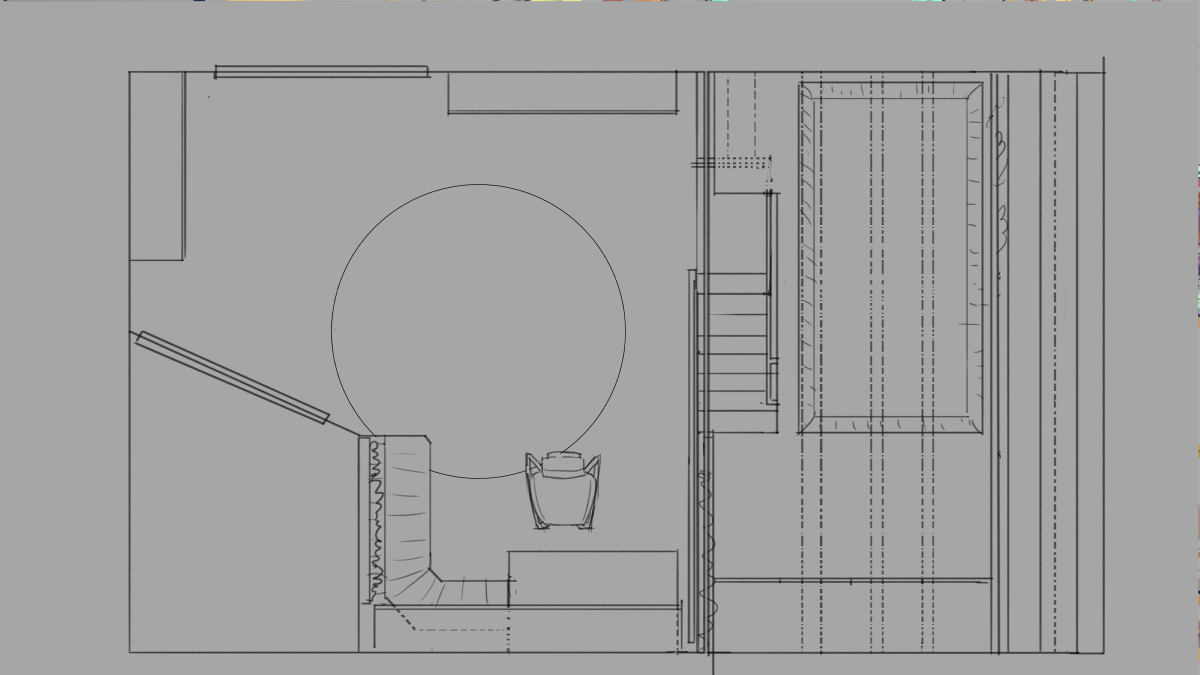
Here you can see the process of defining the layout, content, and style of the cabin:

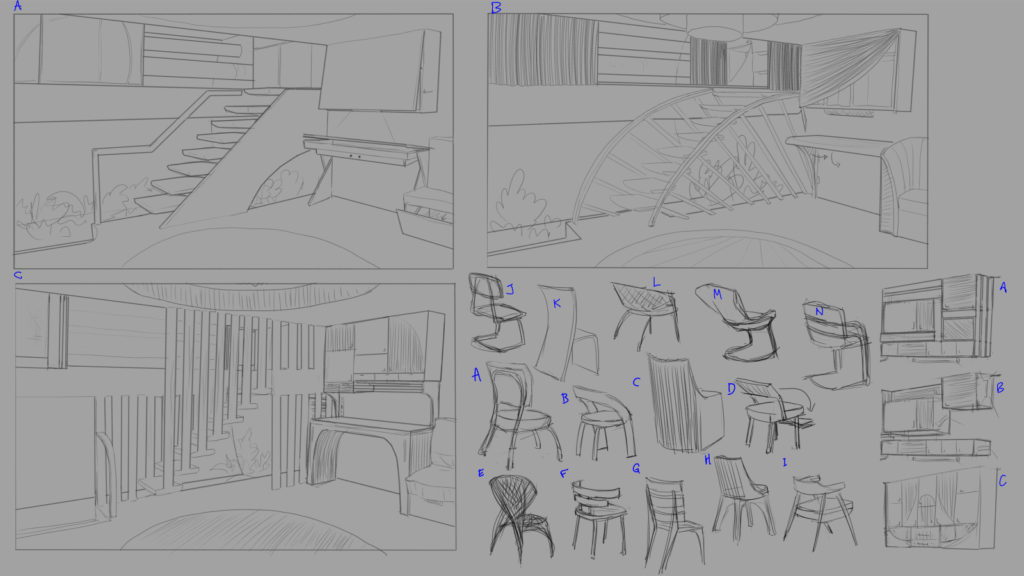
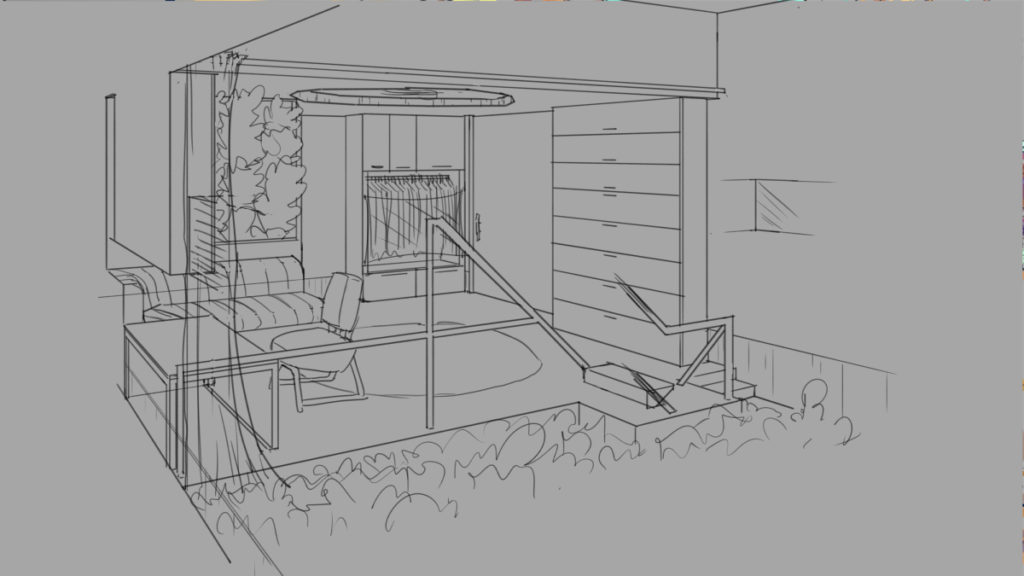
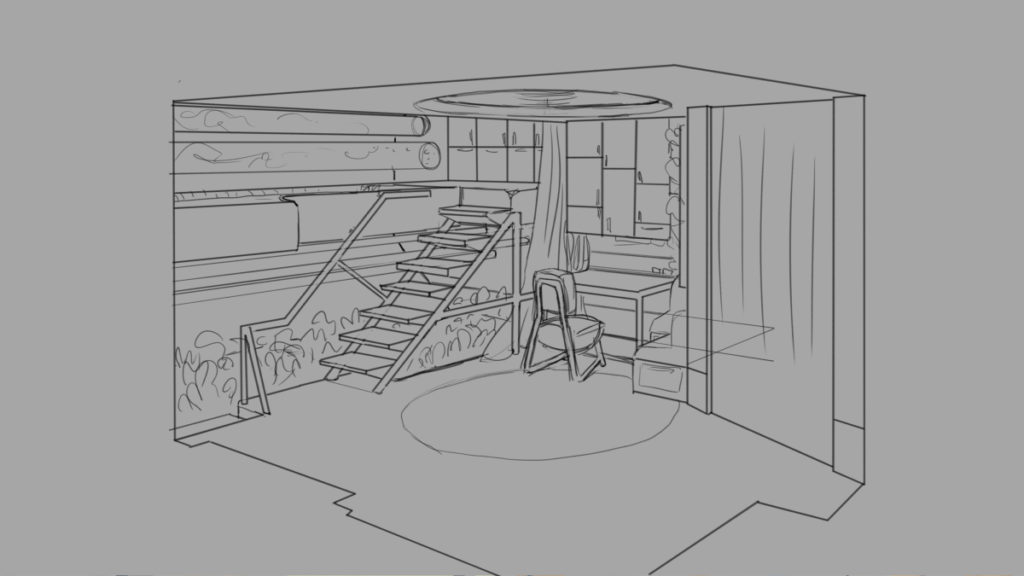
Here is the original floor plan, created after we chose a direction from these three colour thumbnails:
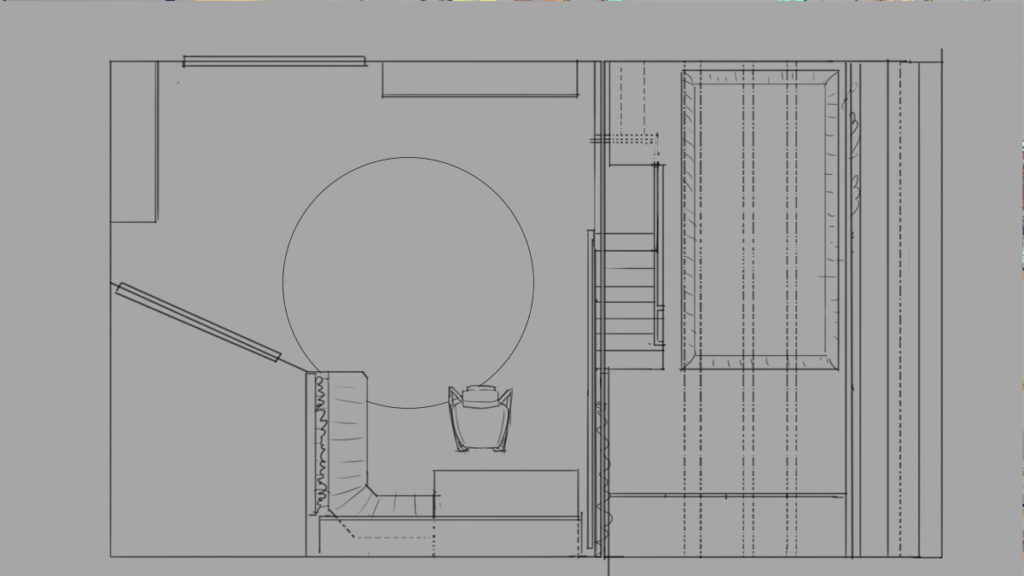
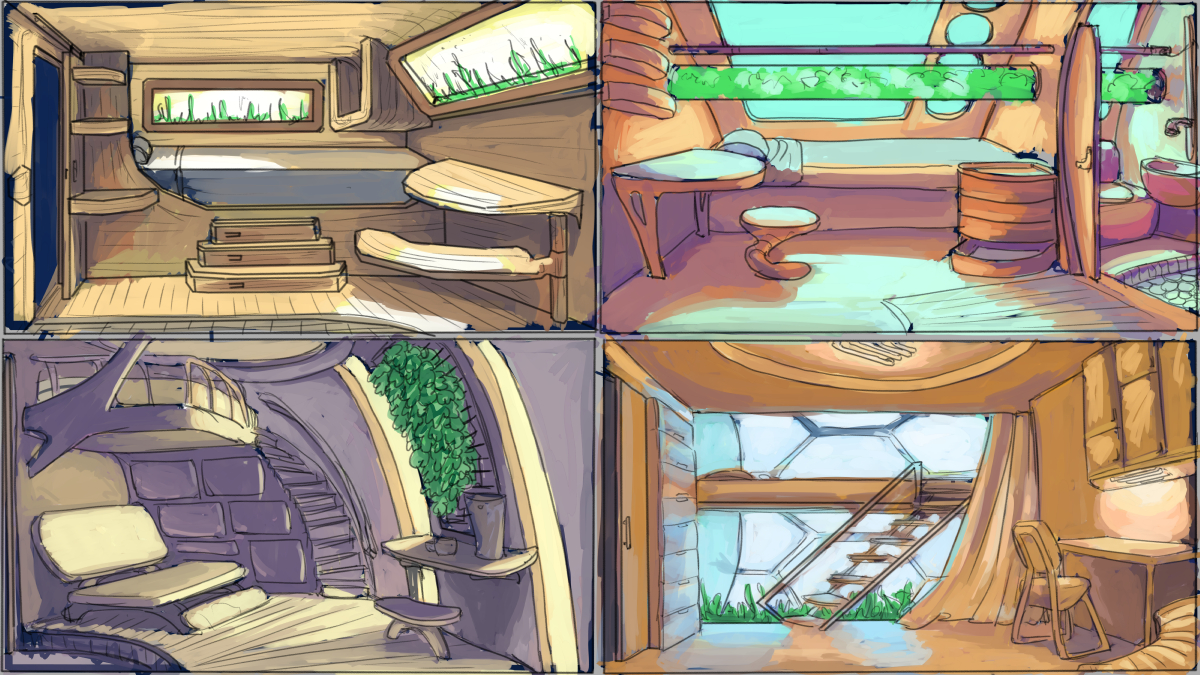
-
These were created for and are owned by Numizmatic Games, for an unannounced game.

Leave a Reply